HUMAIN’s commercial test: converting Saudi AI infrastructure into dependable revenue
ARKHOS | Evidence-led investment review 14 November 2026
HUMAIN’s investment case deserves a more demanding test than either enthusiasm about gigawatts or skepticism about announcements. There is now company-reported evidence of production computing in Saudi Arabia. There are also substantial financing and expansion plans. Those are different kinds of evidence, and they answer different questions.
The commercial question is whether each expansion can secure the equipment, permissions, operating capabilities and customer commitments needed to produce durable cash flow. Our central argument is that the quality of the match between a workload and its delivery system matters more than aggregate capacity alone. That match determines which demand is realistically addressable, when revenue starts and which risks remain with the operator.
1. Establish what the public record actually shows
On 31 August 2026, AMD, Cisco and HUMAIN said MI355X-based infrastructure was live in Saudi Arabia and serving HUMAIN customers domestically and internationally. The same release described a further phase of up to 250 MW, with deployment beginning in 2027 and capacity expected online from the second half of that year. [1]
This is evidence of a reported production milestone, stronger than a memorandum or aspiration. It is still a statement by participating companies, not an independent audit of fleet size, uptime, utilization, customer retention or profitability. The operating claim and the future expansion should not be merged.
On 9 November, Infra announced two facilities totaling up to SAR 2.5 billion: up to SAR 1.1 billion for GPU procurement and deployment representing approximately 25 MW of IT load; and up to SAR 1.4 billion for electrical infrastructure supporting future development of up to 1 GW of IT capacity. [2]
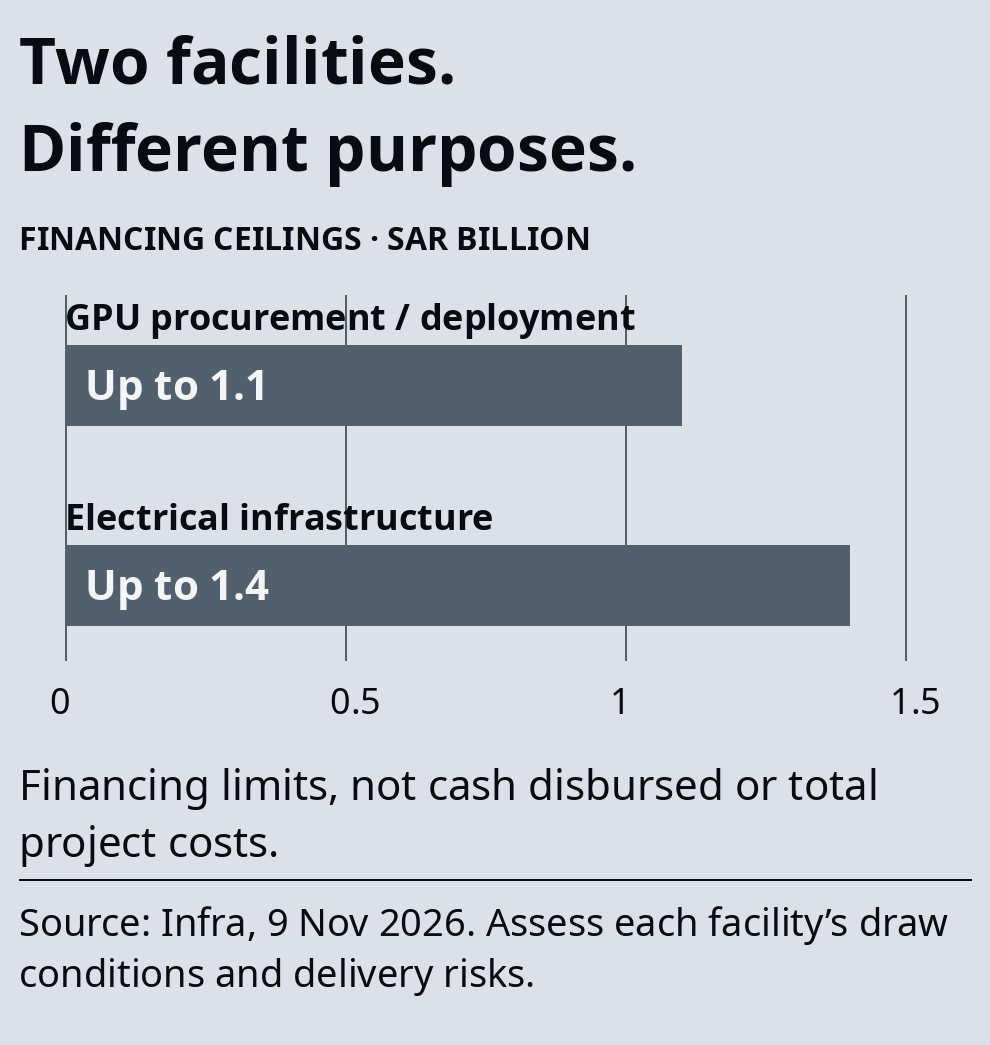
The 25 MW is not an additional operating tranche to stack onto the 1 GW. These are different financing scopes. The announcement neither establishes full disbursement nor provides a project-level investment return. January’s non-binding framework, on which the November transactions build, should not simply be added as separate cash investment. [3]
Our evidence classification is therefore:
| Evidence class | Public evidence reviewed | What remains unestablished by that evidence |
|---|---|---|
| Reported operation | AMD/Cisco/HUMAIN production statement | Independently verified fleet, service performance and economics |
| Financing | Infra’s signed facilities and stated purposes | Actual drawdowns, repayment exposure and realized returns |
| Planned expansion | Future capacity and deployment schedules | Delivery, commissioning, customer ramp and collection |
Absence from a public announcement does not mean these matters are unmanaged internally. It means an outside analyst cannot use them as established facts.
2. Treat chip access as a delivery condition, not a procurement footnote
The relevant asset is a functioning cluster, not a purchase announcement. The delivery test covers accelerators, memory, networking, storage, cooling, power equipment, integration and spare parts. A late component can delay service even when the GPUs themselves arrive. This is an execution risk to test, not a finding of shortages in HUMAIN’s supply chain.
Export compliance adds another dependency. BIS explains that even license exceptions operate under stated conditions. Its licensing guidance distinguishes classification, destinations, end uses and end users. [4] A board should therefore require a transaction-specific assessment of the applicable rules and authorizations before relying on a delivery date. A partnership announcement is not evidence that every future configuration, shipment or customer use is cleared.
We do not infer that a HUMAIN shipment lacks authorization, nor assert a current aggregate quota from historical reports. The exact authorizations and conditions were not reviewed. The useful commercial questions are narrower: who bears delay if approval is not available, can the order be resized, when do non-refundable payments begin, and can an alternative configuration deliver the contracted workload?
Alternative suppliers can reduce dependence on one hardware family while introducing migration and operating costs. A credible substitution plan needs workload benchmarks, software compatibility, networking validation and support capability. A list of two vendors is not, by itself, a tested continuity plan.
There is a concrete disclosed technology decision to examine: the August statement pairs reported production on AMD MI355X with a planned next phase using MI400-series systems and ROCm. [1] That makes generation transition and software readiness relevant diligence questions. It does not establish why the partners chose that sequence, or prove that the transition will be seamless.
3. Segment demand before forecasting utilization
A single “Saudi AI demand” growth rate cannot explain the economics of very different customers. The board should build separate demand cases, then aggregate only after removing overlap.
Large training and research workloads. Potential customers may value large contiguous clusters, interconnect performance, scheduling certainty and engineering support. The commercial hurdle is to demonstrate performance on their actual workload, not compare accelerator names alone. Demand can be concentrated in a few large buyers, making credit quality and renewal terms material.
Enterprise inference. Here, cost per acceptable output, response time, availability, integration and monitoring can matter more than peak cluster size. A successful enterprise pilot does not automatically become continuous production demand. The operator needs evidence of budget ownership, rollout plans and an economic reason for the customer to retain the service.
Regulated domestic workloads. Local delivery and governance controls can be valuable, but eligibility must be assessed by entity, data and workload. Compliance can be a condition of entering a market without being a guarantee of winning it. Procurement cycles, vendor onboarding and customer integration remain commercial constraints.
International customers. The August release reports customers beyond Saudi Arabia, which is relevant operational evidence. [1] It does not disclose an export revenue split or establish competitiveness across all overseas workloads. For each destination, test customer access, applicable export restrictions, data-transfer obligations, network performance, software support, price and collection risk. Export opportunity must be defined by a contestable customer segment, not by the size of the global AI market.
These are proposed commercial segments, not HUMAIN’s disclosed revenue mix. The forecast should show each segment’s route from qualified opportunity to contracted service, billable consumption and collected cash. Counting the same customer in a sovereign-cloud pipeline and a global-compute pipeline would overstate demand.
4. Data sovereignty has several layers, and sector rules matter
Data sovereignty should not become shorthand for “all data must remain in Saudi Arabia.” SDAIA’s transfer regulation permits transfers or disclosure outside the Kingdom subject to the law and applicable conditions, including protection requirements. That is neither an unrestricted permission nor a blanket prohibition. [5]
A sector-specific example illustrates the difference. SAMA’s in-force cloud provision addresses organizations within the framework’s scope using hybrid or public cloud, expressly excluding internal private cloud from that provision. It calls for SAMA approval before using the cloud service or signing the provider contract. It also states a principle of Saudi-based services, with explicit approval for services outside Saudi Arabia. [6] Those provisions should not be extrapolated automatically to every Saudi company, insurer, hospital or government workload.
For a commercial proposal, map the customer entity, regulator, data classification, processing purpose, hosting and backup locations, subcontractors, remote administration and cross-border flows. Confirm the applicable requirements with qualified specialists before promising eligibility. For healthcare, government or critical infrastructure, a financial-sector example is not a substitute for the relevant rules.
Physical location also does not answer every control question. Who controls encryption keys? Who can administer the service? Can data or telemetry reach another jurisdiction? Who can suspend support? What can the customer retrieve on exit? These are procurement and architecture questions to test. A local facility can improve control while still relying on foreign hardware, software and maintenance.
5. Talent determines whether installed capacity becomes a reliable service
A training initiative or hiring target is not evidence of operating readiness. We do not have a verified HUMAIN skills-gap assessment and do not claim one. The investment model should nevertheless identify the people and contracted capabilities required for its service commitments.
The critical roles extend beyond model development: cluster networking, storage and performance engineering; reliability and incident response; cooling and electrical operations; security and export-compliance processes; and customer deployment support. Enterprise adoption adds data engineering and domain integration. These responsibilities may be internal or supplied by partners, but ownership and escalation need to be explicit.
Before expanding, require evidence of staffed coverage, escalation agreements, commissioning acceptance, recovery exercises and workload onboarding capacity. Measure customer time-to-production and incident resolution alongside hardware availability. If a specialist partner supplies the capability, examine substitution, retention of knowledge and what happens if support is withdrawn.
This connects talent to economics: equipment that cannot be commissioned promptly, operated dependably or integrated into a customer workflow can consume cash before generating billable service. “Training more people” is too broad a remedy unless it is tied to the specific operating constraint and its deadline.
6. Build a cash model that survives the commercial details
Power capacity, usable compute and revenue have different units. IT load is not total facility power demand; cooling and other loads must be included in a facility model. Electrical utilization is not billable utilization. Equipment can consume electricity during commissioning or non-billable work, while reserved-capacity contracts may bill customers without full consumption.
For usage-priced services, revenue depends on contractually billable units and realized net price. For reserved capacity, use the actual reservation and minimum-payment terms rather than imposing a usage-only formula. Reconcile revenue with cash collection separately.
Then include the costs needed to deliver the promised service: power and capacity charges, network and software costs, support, fixed operations and replacement capital. Test hardware refresh against customer requirements rather than assuming that accounting life equals commercial life. Keep financing separate from operating unit economics. Debt proceeds are funding, not sales, and refresh capital should not be counted twice as both expenditure and a duplicate cash reserve.
The IEA’s October analysis describes uncertain load ramps and mechanisms including phased connections, minimum payments and collateral to allocate infrastructure risk. [7] For an investor, that means reading both sides of the contract: a minimum purchase may protect a supplier while creating a fixed obligation for the operator. Customer take-or-pay terms can reduce volume exposure but do not remove credit, termination or service-performance risk.
The most revealing stress case is a combined one: power payments start on schedule, customer onboarding slips, market prices soften and refresh comes earlier. We assign no unsupported probabilities or percentages. Use actual contracts and quotes to establish scenario ranges, then identify the peak funding need, recoverable assets and the point at which the next commitment should change.
7. Compare real alternatives, not “invest” against “do nothing”
Build an integrated service now. This can secure availability and early delivery, but requires confidence across supply, legal access, operating capability and customer demand. The approval package should show which obligations become irreversible and how much evidence supports them.
Prepare infrastructure and phase computing. This may preserve expansion options, but smaller orders or later procurement can increase costs or miss delivery windows. The option exists only where contracts allow it. Confirm the cost of reserved infrastructure while equipment and customers ramp.
Partner, lease or buy managed capacity. This may reduce owned-asset exposure, but can transfer risk into minimum purchases, price resets and dependence on another operator. Verify portability, service remedies and exit obligations. Outsourcing does not remove the need for commercial judgment.
A documented example makes the partnered route concrete. TeraWulf’s 6 November 2026 filing states that its Core42 leases cover 60 MW of critical IT load, with an initial ten-year term and two five-year renewal options. It reports that the full contracted capacity was delivered and in service by 30 September. [8] This demonstrates a lease-based route to capacity already in service with a long contractual horizon; it does not establish Core42’s utilization, margins or the capital it avoided. The lesson for comparison is limited but useful: a partner can supply operational capacity while the customer still accepts a substantial commitment period. These are not HUMAIN assets or terms.
Consider two distinct customer cases. For a regulated domestic workload, a smaller compliant service with tested integration may be more useful than a larger generic cluster. For a large overseas training buyer, the decisive evidence may instead be cluster performance, permitted access, availability and the full delivered price. These are analytical examples, not claims about existing HUMAIN customers.
A Saudi enterprise should also compare owning infrastructure with purchasing service and investing the difference in its data and business processes. National strategic value can justify objectives beyond project profit, but support and objectives should be explicit rather than hidden inside a commercial return assumption.
The strongest counterargument: waiting can destroy value too
A cautious, tranche-based approach can fail if equipment slots, grid access or anchor customers require commitments well before demand can be fully proven. Strategic infrastructure can also create demand that would not exist without early capacity. An investor with durable funding, enforceable customer commitments and a scarce delivery window may rationally accept more upfront exposure.
That would weaken the case for phasing if project evidence showed that the cost of lost availability and missed customer revenue exceeded the downside exposure avoided by waiting. Conversely, repeated onboarding delays, weak renewal economics or authorization constraints would strengthen the case for smaller commitments. The thesis is therefore testable: choose the commitment structure that best serves the targeted workloads under evidenced constraints, rather than treating phasing as universally superior.
8. The board decision: scale the evidence, not just the target
ARKHOS’s proposed approval gate is a dated evidence pack for the next tranche:
- Operations: accepted service-ready capacity, measured performance, incident history and customer onboarding throughput.
- Supply and access: configuration-level delivery evidence, applicable authorizations, spares and a tested substitution path.
- Demand: segmented, non-overlapping pipeline; binding terms; credit support; and renewal or expansion evidence.
- Governance: workload-specific legal and data-flow assessment, controls, accountable operators and exit provisions.
- Cash: contract-based ramp, fixed obligations, refresh expenditure, peak funding need and downside decision thresholds.
Set thresholds before commitment, with named owners and dates. If authorization is unresolved, distinguish reversible preparation from non-refundable equipment exposure. If equipment is ready but customer integration is not, test whether phased deployment protects cash without breaking service promises. If the first cohort shows competitive performance and collectible demand, expansion has stronger support than a larger headline target alone.
Our conclusion is constructive but conditional. HUMAIN’s reported production milestone makes the story more substantive than a financing announcement alone. The investment case strengthens when repeatable delivery and customer economics can be demonstrated across distinct markets. The decisive question is not whether Saudi Arabia can announce substantial AI capacity. It is which workloads that capacity can serve competitively, under which constraints, and with what cash outcome for the party bearing the risk.
Sources
[1] AMD, AMD, Cisco and HUMAIN Expand Saudi Arabia’s AI Infrastructure as AMD Instinct Systems Go Live, 31 August 2026. Participating-company operational statement, not an independent performance audit. https://newsroom.amd.com/news/amd-cisco-humain-expand-saudi-arabia-ai-infrastructure/
[2] Infra, Financing agreements of up to SAR 2.5 billion, 9 November 2026. https://infra.gov.sa/en/MediaCenter/News/News-31
[3] Infra, AI and Digital Financing Framework Agreement, 21 January 2026. https://infra.gov.sa/en/MediaCenter/News/News-01
[4] U.S. Bureau of Industry and Security, License exceptions and linked licensing guidance, accessed 14 November 2026. This is general guidance, not a finding about a specific HUMAIN authorization. https://www.bis.gov/licensing/license-exceptions
[5] SDAIA, Regulation on Personal Data Transfer outside the Kingdom, Articles 2 onward, official Knowledge Center page. Accessed 14 November 2026. https://dgp.sdaia.gov.sa/wps/portal/pdp/knowledgecenter/details/PDPL2/!ut/p/z0/04_Sj9CPykssy0xPLMnMz0vMAfIjo8ziPR1dzTwMgw2MDMOcTA3MjH39TE29jY0MQsz1g1Pz9L30o_ArAppiVOTr7JuuH1WQWJKhm5mXlq8fEeAS4GOkX5DtHg4A45XaIQ!!/
[6] SAMA Rulebook, 3.4.3 Cloud Computing, displayed as in force, accessed 14 November 2026. https://rulebook.sama.gov.sa/en/343-cloud-computing-0
[7] IEA, Powering Artificial Intelligence: Executive summary, 14 October 2026. https://www.iea.org/reports/powering-artificial-intelligence/executive-summary
[8] TeraWulf, Form 10-Q for the quarter ended 30 September 2026, filed 6 November 2026, La Lupa section following printed page 58. https://investors.terawulf.com/sec-filings/all-sec-filings/content/0001628280-26-071671/wulf-20260930.htm
The analysis does not establish HUMAIN’s undisclosed contract terms, authorization status, staffing adequacy, utilization or returns. Recommendations are proposed diligence tests, not allegations of deficiencies. Regulatory examples are scoped illustrations, not transaction-specific legal advice. Sources were checked as of the review date; shipment permissions and applicable workload rules require revalidation before commitment.